sciensblogsloving

Silkworms Spin Super-Silk After Eating Carbon Nanotubes and Graphene

The strong, conductive material could be used for wearable electronics and medical implants, researchers say 

Credit: WIKIMEDIA COMMONS 

Silk—the stuff of glossy, exciting apparel—is exceptionally solid. Scientists now report a cunning approach to make the gossamer strings much more grounded and harder: by encouraging silkworms graphene or single-walled carbon nanotubes (Nano Lett. 2016, DOI: 10.1021/acs.nanolett.6b03597). The fortified silk created by the silkworms could be utilized as a part of uses, for example, solid defensive textures, biodegradable therapeutic inserts, and ecofriendly wearable gadgets, they say.

Scientists have already included colors, antimicrobial specialists, conductive polymers, and nanoparticles to silk—either by treating spun silk with the added substances or, now and again, by specifically sustaining the added substances to silkworms. Silkworms, the hatchlings of mulberry-eating silk moths, turn their strings from an answer of silk protein created in their salivary organs.

To make carbon-strengthened silk, Yingying Zhang and her partners at Tsinghua University encouraged the worms mulberry leaves splashed with watery arrangements containing 0.2% by weight of either carbon nanotubes or graphene and after that gathered the silk after the worms spun their cases, as is done in standard silk generation. Treating as of now spun silk would require dissolving the nanomaterials in dangerous substance solvents and applying those to the silk, so the bolstering technique is less difficult and all the more earth well disposed.

As opposed to consistent silk, the carbon-upgraded silks are twice as intense and can withstand no less than half higher push before breaking. The group warmed the silk filaments at 1,050 °C to carbonize the silk protein and afterward examined their conductivity and structure. The altered silks direct power, not at all like normal silk. Raman spectroscopy and electron microscopy imaging demonstrated that the carbon-upgraded silk filaments had a more requested precious stone structure due to the fused nanomaterials.

A few inquiries remain. One is precisely how the silkworms join the nanomaterials in their silk. Another is the thing that rate of the nanomaterials eaten by the worms make it into the silk as opposed to being discharged or generally metabolized. The carbon materials are not obvious in the cross areas of the silk strings, maybe in light of the fact that the nanoparticle substance is low, Zhang says. Noting these inquiries may be an assignment for scientists, she includes.

Polymer scientist Qing Shen at Donghua University reported comparative work in 2014 utilizing 30 all inclusive multiwalled carbon nanotubes, which additionally expanded the silk filaments' quality and sturdiness (Mater. Sci. Eng., C 2014, DOI:10.1016/j.msec.2013.09.041). Zhang says that the littler, 1-to 2 all inclusive single-walled nanotubes her group uses "are more reasonable for joining into the crystalline structures of silk protein."

This work gives a "simple approach to deliver high-quality silk filaments on an expansive scale," says materials researcher Yaopeng Zhang of Donghua University, who has nourished titanium dioxide nanoparticles to silkworms to make superstrong silk impervious to bright corruption. The electrical conductivity of the carbon-strengthened silk may make it appropriate for sensors inserted in savvy materials and to peruse nerve signals, he says.

This article is replicated with consent from Chemical and Engineer


Source By: https://www.scientificamerican.com/article/silkworms-spin-super-silk-after-eating-carbon-nanotubes-and-graphene/

A Plan To Defend Against the War on Science


The vertical pressure amongst specialists and tyrants clarifies what is happening in both the Republican Party and in the European Union with the Brexit vote and the ascent of another dictatorship, and why it is so destructive to science.Credit: CHRISTOPHER FURLONG Getty Images

 Four years prior in Scientific American, I cautioned perusers of a developing issue in American majority rule government. The article, entitled "Antiscience Beliefs Jeopardize U.S. Majority rule government," outlined how it had ended up worthy, as well as frequently required, for lawmakers to grasp antiscience positions, and how those positions went against the center rule that the U.S. was established on: That in the event that anybody could find reality of something for him or herself utilizing the apparatuses of science, then no ruler, no pope and no well off master was more qualified for administer the general population than they were themselves. It was undeniable.

In the years since, the circumstance has become more regrettable. We've seen the development of a "post-certainty" governmental issues, which has standardized the disavowal of exploratory proof that contentions with the political, religious or monetary plans of power. Quite a bit of this refusal focuses, now fairly typically, around environmental change—however not all. On the off chance that there is a solitary element to think about as a gauge that brings out all others in this decision, it is the competitors' states of mind toward science.

Consider, for instance, what has been happening in Congress. Rep. Lamar Smith, the Texas Republican who seats the House Committee on Science, Space and Technology, is an environmental change denier. Smith has utilized his post to start a progression of McCarthy-style witch-chases, issuing subpoenas and requesting private correspondence and declaration from researchers, government employees, government science offices, lawyers general and philanthropic associations whose work demonstrates that a dangerous atmospheric devation is occurring, people are bringing about it and that—shock—vitality organizations looked to sow question about this reality.

Smith, who is a Christian Scientist and appears to delight in his part as the science group's bĂȘte noire, is in no way, shape or form alone. Atmosphere refusal hosts turn into a virtual Republican Gathering board (and dismissing the Paris atmosphere accord a strict one) with a wide greater part of Congressional Republicans embracing it. Sen. Ted Cruz (R–Texas), director of the Senate's Subcommittee on Space, Science and Competitiveness, required some serious energy off from his presidential crusade last December to hold hearings amid the Paris atmosphere summit showcasing surely understood atmosphere deniers rehashing logically undermined arguments.

The circumstance around science has developed so factional that Hillary Clinton turned the expression "I trust in science" into the biggest acclaim line of her tradition discourse tolerating the Democratic Party selection. Donald Trump, by difference, is the principal significant gathering presidential chosen one who is an inside and out atmosphere denier, having called atmosphere science a "fabrication" various times. In his reactions to the association I helped discovered, ScienceDebate.org, which gets presidential hopefuls on the record on science, he let us know that "there is still much that should be examined in the field of 'environmental change,'" putting the term in frighten quotes to give occasion to feel qualms about its existence. At the point when tested on his fabrication remarks, crusade director Kellyanne Conway certified that Trump doesn't trust environmental change is man-made.

In the course of the most recent 25 years the political right has generally sorted out itself along antiscience lines that have turned out to be progressively stark: fundamentalist evangelicals, who dismiss what the natural sciences need to say in regards to human roots, sexuality and multiplication, serve as willing infantrymen for well-to-do business intrigues who dismiss what the ecological sciences need to say in regards to contamination and asset extraction. In 1990, for instance, House Democrats scored a normal of 68 percent on the League of Conservation Voters National Environmental Scorecard and Republicans scored a respectable 40 percent. In any case, by 2014 Democrats scored 87 percent while Republican scores tumbled to a little more than 4 percent.

Such dismissal is basically a tyrant contention that says "I couldn't care less about the confirmation; what I say/what this book says/what my tribe says/what my wallet says goes." This approach is very human, and is not really cognizant. It is, fairly, intelligent of the kind of affirmation inclination researchers themselves constantly prepare for. Francis Bacon noticed the issue toward the start of the logical insurgency, watching: "What a man had rather were genuine he all the more promptly trusts." Conservatives see that numerous researchers are, truth be told, left-inclining. In the event that one is not a researcher, and is moderate, a shorthand is conveyed to shoulder, with suspicion of the science as—as opposed to a goal proclamation—being a politically spurred contention from the left.

Those on the left are more disposed to acknowledge the evidentiary conclusions from organic and natural science however they are not invulnerable to antiscience states of mind themselves. There, logically defamed fears that immunizations cause a mental imbalance have prompted a liberal hostile to inoculation development, imperiling general wellbeing. Fears that GMO (hereditarily adjusted) sustenance is perilous to eat, similarly unsupported, push a national marking development. Fears that PDAs cause cerebrum malignancy or wi-fi causes wellbeing issues or water fluoridation can bring down IQ, none upheld by science, additionally generally begin from the political left.

A lot of this originates from suspicions of purported administrative catch, in which government organizations adjust themselves to corporate interests, a peril the Green Party competitor, Jill Stein, brought up in her response to ScienceDebate.org about immunization. These suspicions are not generally unwarranted, and in the event that one can't believe the unprejudiced nature of government wellbeing controls, the shirking standard turns into the default position and science is denied on the premise that it's corporate PR. This was all around showed by a 2011 fight in San Francisco, where the leading body of managers, every one of them Democrats, voted 10–1 to require PDA shops to caution clients that they may bring about cerebrum disease (a law that was generally reprimanded and later revoked). The distinction is that despite the fact that those on the left look to amplify controls in view of fears that are not generally bolstered by science, those on the privilege restrict directions that are.

Such affirmation inclination has been empowered by an era of college scholastics who have educated a destructive brand of postmodernist personality legislative issues that contends truth is relative, and that science is a "meta-account"— a story devised by the decision white male tip top so as to hold control—and along these lines suspect. The cases of science, these scholastics contend, are not any more advantaged than some other "method for knowing, for example, dark truth, female truth or indigenous truth. We can't know, a Minneapolis teacher as of late contended, that Earth circumvents the sun, for instance, in light of the fact that these sorts of perspectives have been unstuck by outlook changes all through history. In this manner, each of us builds our own truth, and the occupation of an instructor or a columnist is to encourage that procedure of disclosure.

The thoughts of postmodernism adjust well to the character governmental issues of the left, and they have engaged burdened voices, which dependably adds to the discussion. In any case, what works for this situation for political talk is verifiably false when connected to science. An exploratory articulation stands free of the sex, sexual introduction, ethic foundation, religion or political character of the individual taking the estimation. That is the general purpose. It's attached to the protest being measured, not the subject doing the measuring.

By undermining science's claim of objectivity, these postmodernists have unwittingly established the philosophical framework for the new ascent of tyranny. Since if there is no target confirm that has extreme validity, how is one to settle contending cases of truth, for example, those made by Trump? Without target truth, the nattering of warring intellectuals can go on perpetually, and must be settled by those with the greatest stick or the loudest bull horn—to put it plainly, by dictator declaration, a circumstance not of postmodernism but rather of premodernism. Which is precisely what's going on. Furthermore, which runs totally counter to the edification thoughts of American majority rule government and the news-casting that should educate it.

The issue is that the risks science is uncovering are genuine, and the inability to manage, advanced for the sake of free market financial aspects, is itself experimentally unsupported. The detonating human populace combined with growing innovative power is having a significant aggregate effect on a nonexpanding planet. At the point when Adam Smith initially offered the libertarian thought of the automatic market's "imperceptible hand," the world was adequately boundless and depending just on market powers to deliver the most noteworthy great appeared to be sensible in light of the fact that one was never worried with waste that wouldn't stream away or assets that wouldn't renew.

Be that as it may, the model turns into an issue when the world is restricted, populace has developed exponentially, we are swimming in waste and confronting diminishing assets, and our aggregate fumes is warming the planet. These are logical truths, and confronting them infers direction of the free market. It's nothing unexpected, then, that the science has isolated along political lines between those on the left, who support individual ethical quality and aggregate duty by means of direction and those on the right who support aggregate profound quality and moral obligation through control's expulsion.

Industry's war against science isn't constrained to environmental change. A large group of advertising effort throughout the most recent five decades have gone through billions of dollars with the express motivation behind sowing open uncertainty about science. The strategies are normally the same: highlight filtered out actualities gave by paid doctors or researchers whose option conclusions bolster your motivation; underscore the requirement for sound civil argument (when there truly is none); assault the respectability of standard science and
 
source by:https://www.scientificamerican.com/article/a-plan-to-defend-against-the-war-on-science/ 

Hurricane Matthew blamed for 4 US deaths, sparks flash-flood fears


 Photos: Hurricane Matthew Hits US Coast.

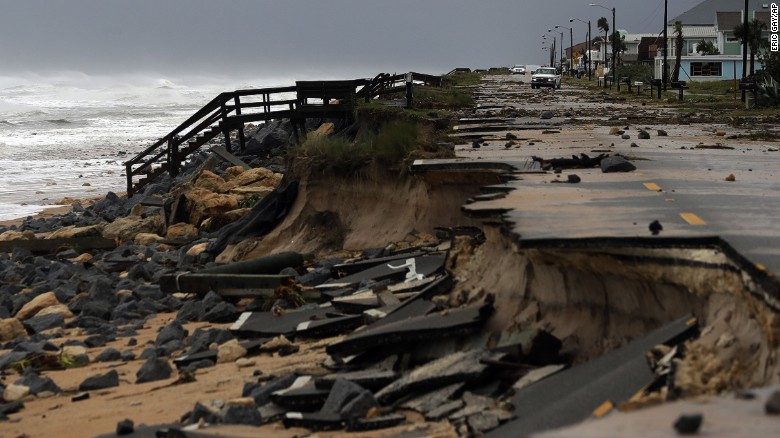
Floridians along the Atlantic drift were adapting Friday to rising water as Hurricane Matthew splashed the state with rain and as solid winds pushed waves over shorelines.

Meteorologists said storm surge was measured at more than 4 feet in a few ranges.

"We are seeing effects at this moment from St. Augustine to Jacksonville Beach. Tragically, this is going to proceed as the night progressed," Gov. Rick Scott said.

The tempest, which is reprimanded for four passings in Florida, started streak surge concerns. The National Weather Service issued a notice for parts of Nassau County, north of Jacksonville.

"The mix of a hazardous tempest surge, the tide and huge and ruinous waves will bring about typically dry ranges close to the drift to be overwhelmed by rising waters moving inland from the shoreline," the National Hurricane Center said.
Extraordinary concern encompassed Jacksonville's St. Johns River, which could be overpowered by water pushed into it by the tempest. The sea tempest focus said a tide gage reported tempest surge of 4.28 feet.

Subsequent to executing hundreds in Haiti and other Caribbean countries, Matthew's alarming force prompted the passings of four individuals in Florida. The rundown incorporated a lady in her 60s in Volusia County, hit by a falling tree, and a 82-year-old man and a lady in St. Lucie County, authorities said. The last two had medicinal crises and responders were not able contact them in time due to dangerous climate.

A lady in upper east Florida passed on after a tree fell on her camper trailer, the Putnam County Sheriff's Office said.
Source By: http://edition.cnn.com/2016/10/07/us/hurricane-matthew-florida/

Hurricane Matthew's US Death Toll Rises to 13; More Than 2 Million Without Power


No less than 13 individuals in three U.S. states have kicked the bucket as a consequence of Hurricane Matthew, which has likewise left 2.2 million family units and organizations without power over the Southeast area. The loss of life expanded as the tempest climbed the Atlantic Coast, bringing exuberant rain, effective winds, a tempest surge and the potential for calamitous flooding.

North Carolina Gov. Congratulate McCrory said Saturday that the state recorded three tempest related passings - one in Samson County because of hydroplaning and two in Bladen County after a vehicle was submerged in surge water.

"This is an intense and destructive tempest," McCrory said at a question and answer session Saturday evening. He asked general society to stay goes dirt road romping and remain inside.

Six individuals additionally lost their lives in Florida because of the tempest, which at one point left 1 million family units and organizations without power in the Sunshine State.

In Georgia, four passings were accounted for.

The tempest touched down in South Carolina, southeast of McClellanville, at 11 a.m. ET as a Category 1 sea tempest with most extreme managed winds of 75 mph, as indicated by the National Hurricane Center.

It is required to debilitate further to a post-hurricane by Saturday night, ABC News meteorologists said.

Regardless of the tempest's debilitating, the National Hurricane Center cautioned Saturday morning of "solid winds and perilous tempest surge" along South Carolina's drift and "overwhelming downpours and windy winds spreading inland."

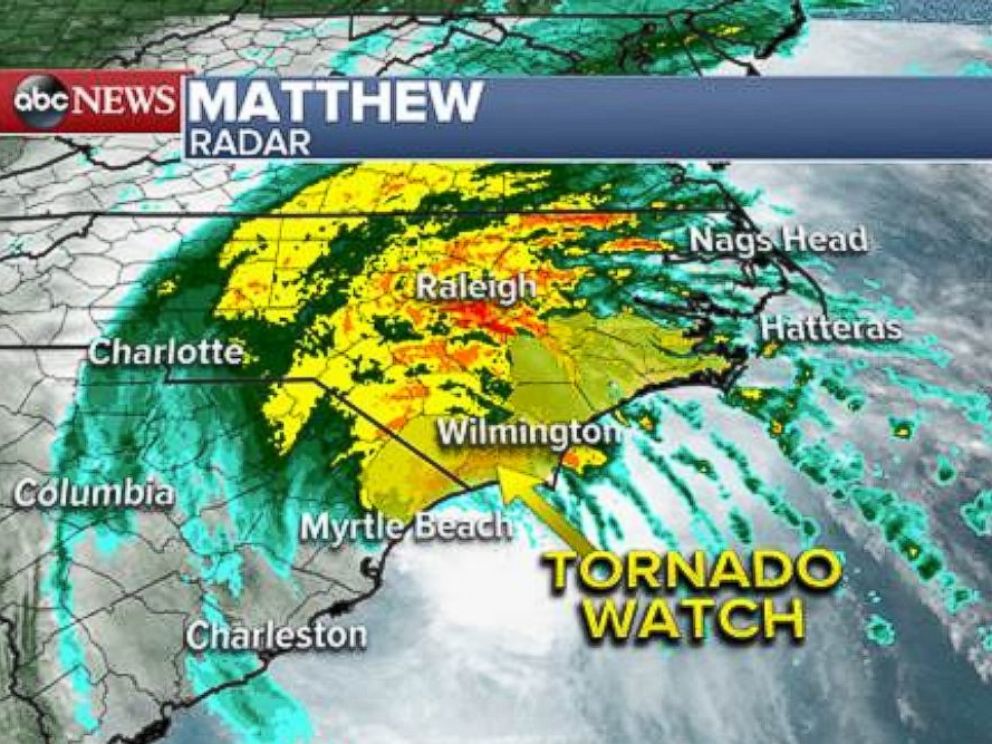
The National Weather Service likewise posted another tornado look for parts of upper east South Carolina and eastern North Carolina until 4 p.m. ET Saturday.

"A disconnected tornado or two will be conceivable today along the shore of North Carolina and northern South Carolina," the National Hurricane Center, a division of the National Weather Service, said in its consultative at 8 a.m. ET. "Albeit debilitating is conjecture amid the following 48 hours, Matthew is relied upon to remain a storm while the inside is close to the shorelines of South Carolina and North Carolina."


Following Hurricane MatthewPrior Saturday, Hurricane Matthew brushed Georgia's drift on its way up the shoreline. Starting 2:30 p.m. ET, the tropical storm was moving upper east at 12 mph with the eye of the tempest right close Myrtle Beach, South Carolina. A glimmer surge crisis was issued for Myrtle Beach and encompassing regions, with more than a foot of rain falling in a few spots.


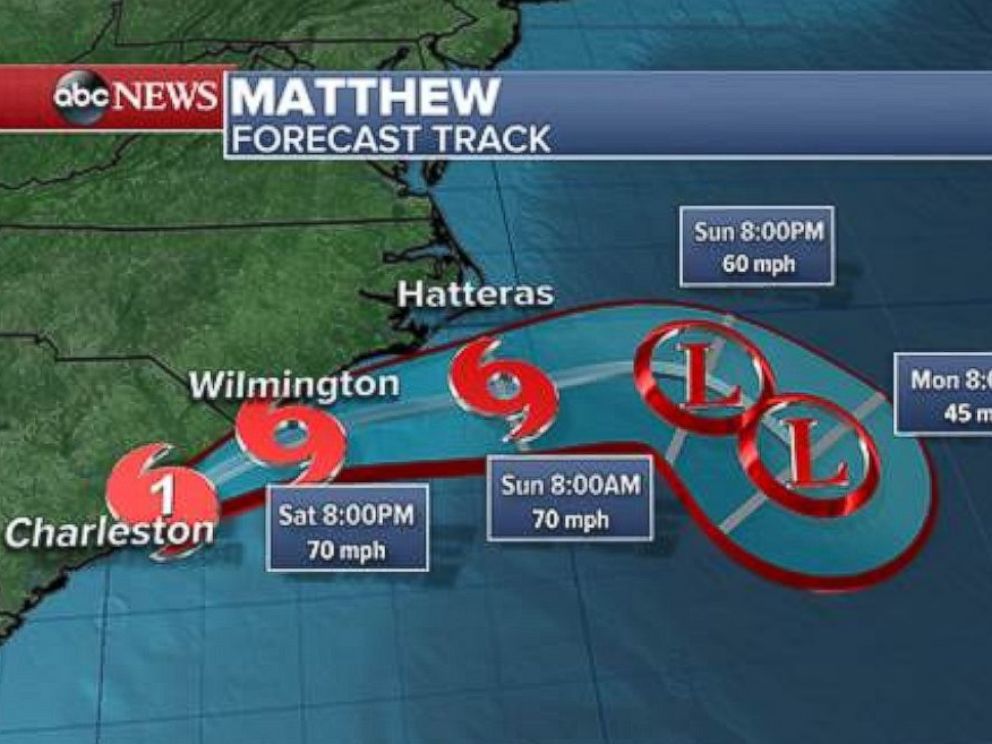
"On the conjecture track, the focal point of Matthew will keep on moving close or over the shore of South Carolina today, and be close to the bank of southern North Carolina by this evening," the National Hurricane Center said Saturday in its 8 a.m. ET counseling.

"While debilitating proceeds ... the tempest development will get speed, huge effects will proceed for about the following 24 hours," ABC News meteorologist Daniel Peck said Saturday. "Our greatest concern is extraordinary precipitation and glimmer flooding."


Risky Combination of Winds, Rain and Storm Surge

Starting late Saturday evening, Matthew's sea tempest compel winds stretched out outward up to 45 miles from the tempest's middle off the South Carolina drift, while to some degree less solid winds stretched out outward up to 185 miles. Twist blasts of 76 mph were accounted for at South Carolina's Folly Beach and 55 mph in Orangeburg.

Storm surges that could bring about flooding have a been a worry here and there the drift. The National Weather Service measured a record tide level of more than 12 feet at the mouth of the Savannah River, which outskirts both South and North Carolina. Forecasters cautioned that the blend of a risky tempest surge, the tide and expansive waves could bring about rising waters to move inland from the shoreline to surge regularly dry regions close to the drift.

The water level could transcend ground as high as 9 feet in a few spots from North Carolina south. The National Hurricane Center cautioned early Saturday of "life-debilitating immersion" along the coastline amid the following 36 to 48 hours.

On Saturday, Charleston County Emergency Medical Services in South Carolina suspended its administration countywide, cautioning that high-traverse or uncovered extensions are risky for open go because of high winds. A time limitation was actualized in Charleston between Saturday 8 p.m. ET through Sunday 8 a.m. ET.

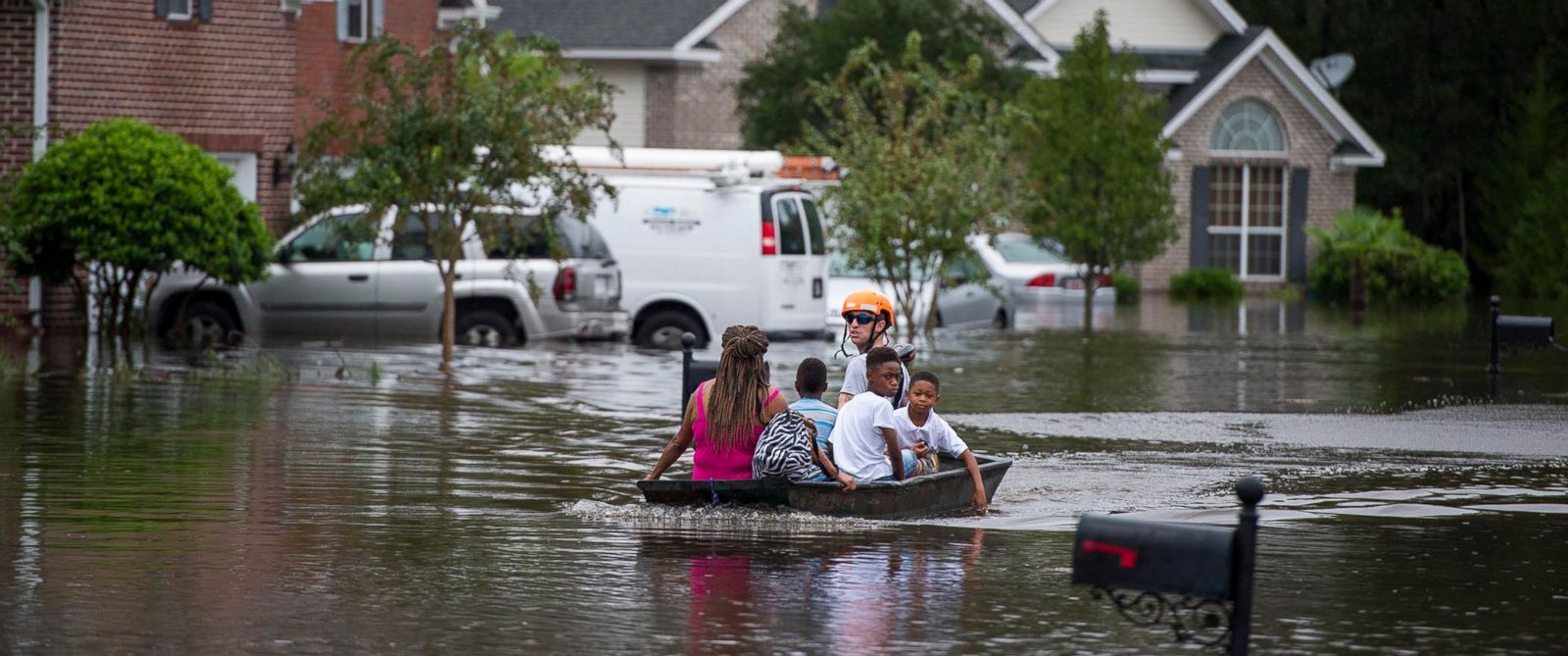
Tropical storm Matthew is relied upon to create an aggregate of 8 to 12 inches of rain close and east of I-95 in South and North Carolina, with the likelihood of up to 15 creeps in segregated spots. Forecasters said the precipitation amassing could bring about savage surges and blaze flooding.

Almost 17 inches of rain were recorded at Hunter U.S. Armed force Airfield in Savannah, Georgia over a 48-hour time frame, as indicated by the National Hurricane Center.

More than 342,000 homes and organizations were without power in Georgia, 663,000 in South Carolina and 200,000 in North Carolina on Saturday, as authorities attempted to reestablish power. Floodwaters, brought down trees and garbage obstructed streets in quite a bit of Matthew's tempest way crosswise over three states, rendering I-95 in South Carolina impassible early Saturday.
Source By:  http://abcnews.go.com/US/hurricane-matthew-batters-florida-coast-dead-million-lose/story?id=42608853

Weakened Hurricane Matthew still deadly as it buffets U.S. Southeast


Tropical storm Matthew pummeled into South Carolina on Saturday, pressing a lessened yet still intense punch subsequent to killing very nearly 900 individuals in Haiti and bringing about significant flooding and across the board control blackouts as it evaded Florida and Georgia.

Presently debilitated, the most capable Atlantic tempest since 2007 unleashed exuberant rains and harming winds in Florida before beating gradually north to splash seaside Georgia and the Carolinas. Twist speeds at early afternoon had died down by almost half from their crest around a week back to 75 miles for every hour (120 kph), diminishing the tempest to a Category 1 tropical storm, the weakest on the Saffir-Simpson size of 1 to 5.

Matthew, which bested out as a savage Category 5 storm days prior, made U.S. landfall close McClellanville, South Carolina, a town 30 miles (48 km) north of Charleston that was crushed by a Category 4 storm in 1989.

The National Hurricane Center in Miami said Matthew disregarded Myrtle Beach, South Carolina, on Saturday evening, and cautioned of possibly life-debilitating flooding in Georgia and North Carolina even as the tempest moderated as it furrowed inland.

Starting 11 p.m. EST (0300 GMT), the tempest was around 35 miles (55 km) south of Cape Lookout, North Carolina, the middle said in a counseling.

The focal point of the tempest will move close or south of the North Carolina drift from the get-go Sunday and east of the state later in the day as it debilitates.

The tempest was reprimanded for no less than 11 passings in the United States - five in Florida, three in North Carolina and three in Georgia, including two individuals slaughtered by falling trees in Bulloch County, the province coroner said.

Power was accounted for thumped out to more than 2 million family units and organizations in the U.S. Southeast, the greater part of those in Florida and South Carolina.

North Carolina Governor Pat McCrory asked inhabitants on Saturday night to stay drives through rough terrain and walkways to maintain a strategic distance from "fatal conditions" brought on by extreme flooding and garbage.

Conditions in eastern and focal North Carolina were relied upon to intensify as the tempest edged along the drift and toward the Outer Banks obstruction islands, the senator said.

Forecasters cautioned that across the board flooding was conceivable from substantial rain - 15 inches (40 cm) was relied upon to fall in a few regions - alongside gigantic tempest surges and high tides.

The tempest stricken extend of the Atlantic Coast from Miami to Charleston, an about 600-mile drive, envelops the absolute most understood shorelines, resorts and verifiable towns in the southeastern United States. Parts of Interstate 95, the fundamental north-south lane on the East Coast, were shut because of flooding and fallen trees, state authorities said.

Streets in Jackson Beach, Florida, were covered with garbage, including pieces from a noteworthy dock ousted by the tempest, with a few convergences obstructed by to a foot of standing water. Beachfront organizations endured direct harm.

"We rode out the tempest. It wasn't this awful at our home, however here there's a great deal of harm," said Zowi Cuartas, 18, as he watched spectators get smashed signs close to the shoreline.

Florida Governor Rick Scott said more than 6,000 individuals stayed in safe houses overnight, however he seemed alleviated that the state had been saved from more prominent mischief.

"We're all honored that Matthew stayed off our drift," he said. He anticipated power would be reestablished to most homes by Sunday evening.

leftright

29/29leftright

Avenues in downtown Charleston, known for its memorable waterfront design, were overwhelmed to the highest points of tires on some stopped autos, and a couple of occupants could be seen swimming close to the city's ocean divider as high tide drew closer.

Tony Williams, 54, who said he is destitute, rode his bike against colossal twist blasts in the wake of spending the night in an open carport. "I just became weary of laying where I was laying," he said.

On Daufuskie Island close to the Georgia fringe, author Roger Pinckney, 70, said it "blew like damnation" as he dug in at home in spite of clearing notices amid the tallness of the tempest's rage, however he developed unscathed.

Somewhere in the range of 8 inches (20 cm) of rain fell in the Savannah, Georgia zone, bringing down trees and creating flooding.

The National Weather Service said record-high tides were recorded along the Savannah River at the South Carolina-Georgia outskirt, topping at 12.6 feet, outperforming those from Hurricane David in 1979.

Despite the fact that step by step debilitating, Matthew was figure to remain a typhoon until in any event Sunday, when it was relied upon to crawl far from shore, the NHC said.
Source By: http://www.reuters.com/article/us-usa-matthew-idUSKCN12807E

Physics Nobel Awarded for Breakthroughs in Exotic States of Matter

David Thouless, Duncan Haldane and Michael Kosterlitz share the 2016 Nobel Prize for work clarifying the topological underpinnings of superconductivity and other peculiar wonders

 The 2016 Nobel Prize in Physics was granted for hypothetical work clarifying the principal underpinnings of superconductivity—the sans resistance conduction of power that can make magnets suspend, as observed here.Credit: GETTY IMAGES

The Nobel Prize in Physics 2016 was part, with one half going to David J. Thouless at the University of Washington, and the other half going to F. Duncan M. Haldane at Princeton University and J. Michael Kosterlitz at Brown University. The Prize was granted for the scholars' examination in consolidated matter material science, especially their work on topological stage moves and topological periods of matter, marvels basic intriguing conditions of matter, for example, superconductors, superfluids and thin attractive movies. Their work has given new bits of knowledge into the conduct of matter at low temperatures, and has established the frameworks for the production of new materials called topological covers, which could permit the development of more complex quantum PCs.

Topology is a branch of science that studies properties that exclusive change incrementally, in whole number strides, as opposed to constantly. Thors Hans Hansson, a physicist at Stockholm University who served on the current year's Nobel Committee, clarified the center idea of topology amid the honors declaration by pulling a cinnamon bun, a bagel and a Swedish pretzel from a sack. "I brought my lunch," he clowned, then clarified that, to a topologist, the main contrast between the three sustenances was the quantity of gaps in them, as opposed to their taste. A cinnamon bun has no gaps, though a bagel has one, a pretzel two. To a topologist, then, the bun would fall in the same class as a saucer, though the bagel would be matched with a container and a pretzel with a couple of exhibitions. Thouless, Kosterlitz and Haldane's prize-winning bits of knowledge rotate around the possibility that these same sorts of "topological invariants" could likewise clarify stage changes in matter, yet not commonplace ones, for example, a fluid solidifying to a strong or sublimating to gas. Rather, the stage changes the scholars considered occurred mainly in thin two-dimensional movies cooled to cryogenic temperatures.

The main knowledge came in the mid 1970s, when Thouless and Kosterlitz cooperated to topple the long-held agreement that stage moves, for example, superconductivity (the stream of current without resistance) and superfluidity (a liquid having zero erosion) just can't happen in two-dimensional frameworks because of warm vacillations, even at supreme zero. They found rather that frosty two-dimensional frameworks could in truth experience stage moves through an absolutely unpredicted marvel, the arrangement of sets of vortices at low temperatures that then abruptly float separated as the temperature ascends past a specific warm limit. This "KT move" (for "Kosterlitz-Thouless") is widespread, and has been utilized to study superconductivity in thin movies and in addition to clarify why superconductivity disseminates at higher temperatures.

Next, in the 1980s, Thouless and Haldane each concentrated how the conductivity of power in quantum frameworks took after topological standards. Thouless' work inspected the quantum Hall impact, a formerly known marvel in which solid attractive fields and cool temperatures in thin layers of semiconductors cause electric conductance to change just in exact number strides, instead of consistently. The wonder had evaded clarification until Thouless gathered the electrons in such frameworks were shaping what is known as a topological quantum liquid, acting on the whole to stream just in number strides. Autonomously, Haldane demonstrated that topological quantum liquids can shape in semiconductor layers even without solid attractive fields, expanding on his prior expectations of comparative topological conduct in one-dimensional chains of charged particles.

Together, the bits of knowledge from Thouless' and Haldane's work have demonstrated urgent in creating and comprehension topological encasings, novel substances that piece the stream of electrons in their insides while at the same time directing power over their surfaces. This special property could make topological covers valuable for ferreting out new sorts of basic particles, and for framing hardware inside quantum PCs. Researchers are as of now examining and at times making other much more outlandish materials, topological superconductors and topological metals that every hold immeasurable potential for new applications in calculation and hardware.

This work "has let us know that quantum mechanics can carry on much more peculiarly than we could have speculated, and we truly haven't saw every one of the potential outcomes yet," Haldane said in a phone meet. "We have far to go to find what's conceivable, and a great deal of these things were things that one wouldn't have at first envisioned were conceivable."

Source BY:https://www.scientificamerican.com/article/physics-nobel-awarded-for-breakthroughs-in-exotic-states-of-matter1/

Is California About to Be Destroyed by a Killer Quake?


Credit: USGS

 Is California going to encounter a monstrous tremor this week?

Most likely not.

Yet, according to my Facebook channel in the course of the last couple of days, a lot of individuals are concerned. Notices have gone out that there's an elevated danger of a noteworthy shudder on the San Andreas deficiency because of a seismic tremor swarm close to the Salton Sea. Furthermore, yes, that swarm has changed conjectures a bit. Give me a chance to have John Vidale of the Pacific Northwest Seismic Network clarify it:

In the Salton Sea, the tremor swarm a week ago changed the chances of a seismic tremor of at any rate M7 on the San Andreas issue to between 1 in 3000 and 1 in a 100 for the next week.

That is all the spate of news stories implies. No new revelations, yet there is another eagerness to tell the general population of little changes in the chances of tremors, and new techniques to be to some degree particular in the extent of the probabilities.

In the phrasing that seismologists utilize, this is determining - assessing the rate of tremors, not foreseeing - which is think about when, where, and how enormous will be an up and coming shake. Additionally, figures have a tendency to be longer chances, while on the off chance that one says a tremor is unquestionably going to happen, we think of it as all the more a forecast, regardless of the fact that the area is ambiguous.

As my companion Garry Hayes, who shows topography at Modesto Junior College, puts it:

Swarms happen constantly, and numerous don't prompt more action. Be that as it may, on uncommon events they do prompt bigger tremors. How to react? Alarm? Obviously not. Be that as it may, it resembles checking your flame cautions on sunlight reserve funds: check and check whether you are prepared for a huge seismic tremor. Do you have water, nourishment, emergency treatment unit? Do you have a family get ready for in the event that you are isolated? Audit the dangers and desires of an expansive seismic tremor, and teach yourself. Furthermore, most critical of all: don't accept fiery web features.

So. This is what you have to do to get ready in case you're in tremor nation. What's more, in case you're in California, head on over to the Great California ShakeOut's site to take in more about California's particular dangers, and ventures to take that are particular to California
.

It's alright. You have this. Regardless of the possibility that the enormous one comes, you can be set up to survive it.


Source By: https://blogs.scientificamerican.com/rosetta-stones/is-california-about-to-be-destroyed-by-a-killer-quake/